Eastern Hardwood Nuts
Orchards and vineyards are widely adopted in the eastern US as an agricultural method without open fields. Generally they’re focused on high-value fruits and nuts like apples, almonds, grapes, pecans, and blueberries. However, we have many more food-producing woody plants than are used in modern orchard systems.
Oaks
The oak tree is of such deep importance it will be impossible for us to adequately describe their role. The tree is the center anchor of biodiversity wherever it occurs. Oaks on average live for almost a thousand years – growing for 300, mature for 300, and declining for 300 – and each stage provides for the surrounding ecosystem in different ways. Humans have always valued the oak for its sturdy fine wood – good for both construction and tools as well as heating. But less well known today is the importance of acorns to our ancestors and some people still living today.
The acorn has sustained people around the world for millennia. There are almost too many to list, from the Dahesas of spain, the acorn eaters of Akkadia, the Korean foraging traditions, and the central use by the Chumash and other nations of the west. Acorns are nutritionally similar to grains, and play a similar role in the cultures who use them as foods.
The oak tree does not bear every year, unlike the predictable yields of wheat or rice. Instead there is an unpredictable synchronization between oak trees, where they seemingly decide to produce an overabundance some years and little to none on others. This is known as masting. Explanations for this unpredictability include managing pests, responses to weather, and improving the cross-pollination between trees. Trying to predict masting cycles is an active topic of research with significance to forest management and potential agricultural use, but still remains an unsolved problem.
Acorns are a nut with a thin easily-cracked shell, but the actual seed inside is rich with bitter tannins (the same chemicals that make tea taste bitter) which can have negative health effects in significant quantities. The amount of tannins vary between species and individual trees. Generally speaking low-tannin (sometimes called ‘sweet’) acorns are more appealing to wildlife, and have historically been a more central food source to people. Higher tannin acorns are usually more abundant for human collection due to the lack of immediate attention from squirrels and other animals.
Tannins are ‘water soluble’ – that means that it can be washed away in water, a lot like salt. This is similar to olives which must be ‘cured’ to remove their tannins. Most methods of acorn processing therefore have involved grinding and then holding the acorns under moving water to rinse away the bitterness. The processing time varied based on both tannin levels and the amount of water being used – but typically takes hours or days to complete. Cooking by boiling or toasting is also not uncommon, as is nixtamalization (using strong basic solutions to break down chemical bonds), and brining in salt. All methods require time and patience, but can yield large quantities of flour that is similar to typical grain-flours we eat every day.
Oaks in the east fall into two main groups – the ‘white oaks’ and ‘red oaks’ (there are other smaller groups that are not common in the region). White oaks have leaves with rounded edges, take a single year to produce acorns which generally have lower tannins, drop early in the season (often in the late summer), and germinate a few weeks after falling. They usually trigger a feeding frenzy in the woods – being eaten by nearly anything that has a mouth big enough to fit an acorn inside. Red oaks meanwhile have spiky-edged leaves, take two years to produce more tannic acorns that drop later in the season (some falling in the late autumn and early winter), and don’t germinate and begin growing until the spring. These can sometimes litter the forest floor and only begin getting picked off when other food sources dwindle.
There is an orchestra of oaks in the forests, where each species plays their note at their set time. With the chestnut oak in the white oak group often dropping their acorns several weeks before other species, and the northern red oak sometimes arriving almost months later. The weather, latitude, and other factors modulate these drop times – so they’re ultimately unique to each woodland and each season.
Hickories
Hickories are a common sister tree in oak woodlands. Their shared woodlands are known as Oak-Hickory forests and are the most widespread of the forest types in both eastern and central North America. Archeological evidence shows that people have been collecting and storing acorns and hickory nuts for millennia. One notable dig site showed over 13,000 hickory nuts piled in a storage pit during the Late Archaic period (around 3,000-5,000 years ago).
Unlike oaks, hickory nuts do not require special processing. They are sweet and delicious and can be eaten right out of their shells. The most well known hickory species is the Pecan (which is the only species in the group which has been widely adopted as an orchard species) but the wild hickory species outside of cultivation are considered by some to the best tasting nuts in the world. The taste and use varies by tree – the bitternut being most useful as an oil (the nut flesh being too bitter to eat directly), shellbark as the largest and sweetest, shagbarks the most easy to crack, and so forth.
Among the Cherokee people, Kanuchi is a traditional food made of smashed hickory nuts boiled into a rich milk, often with a starch like rice or grits. This is one of the best ways to enjoy hickory nuts. In our household we pass the milk through a blender and add maple syrup for a comforting winter drink similar to milky hot chocolate or warm horchata.
Groups such as the Northern Nut Growers Association have been developing new hybrids and varieties of hickory, which members have been growing and putting out for sale. These types are selected for characteristics such as cold tolerance, shell thickness (thinner is better), sweetness, and size of nut.
Chestnut
The American Chestnut used to be a common feature in the northeastern portions of the oak-hickory forests, these were called ‘oak-hickory-chestnut forests’. These enormous canopy trees were sometimes called the redwoods of the east, as they were the tallest members of their forest community – averaging 100′ tall, and 5′ wide. Unfortunately the tree became functionally extinct in the early 1900’s as the chestnut blight spread from imported Japanese chestnuts.
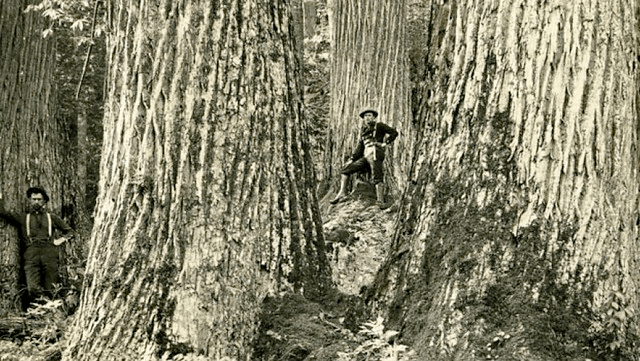
Like the hickory and oak, chestnuts were central to regional food cultures. The Indigenous Nations all have unique names and relationships with the trees. The settlers heavily relied on Chestnuts as a food source up until its extinction, with reports of railroad cars overflowing with chestnuts destined for city consumers.
Unlike the oak and hickory, the nuts of the chestnut family require virtually no processing. They have thin shells like the acorns and can be eaten fresh like the hickory nut. After the prickly burr is carefully peeled away, stepping on a nut is enough to crack the shell open and the flesh easily picked out. Although not required before eating, roasting chestnuts is a continued practice to concentrate the sugars into a sweet caramelized treat.
People have been trying to restore the chestnut through a range of strategies. Some are using genetic modifications, while others are using breeding programs. Some folks grow the European or Asian chestnuts as a functional replacement for the tree. Their argument is that the existence of the chestnut genus on the landscape, with similar sized nuts – is important for wildlife and provides great value to people.
A remaining native species in the chestnut family known as the Chinquapin is still present in the landscape. The chestnut tree was decimated by the blight because it kills the tree’s above-ground growth. Chinquapins have an advantage because they are small shrub-like trees, and when blight takes down a large stem they can still recover. New limbs and stems are sent from the ground and they proceed growing.
Chinquapins have small nuts – once peeled they’re around the size of a peanut. This historically made them less central in focus than the chestnut in terms of economic focus and cultural lifeways. But their continued existence in the landscape highlights their unique value.
Beech
The Beech tree grows in different habitats than the other trees mentioned so far. As it’s not able to withstand fire, it’s commonly found with other shady fire-intolerant species like maple and birch. They also trend much further north spanning well into Canada.
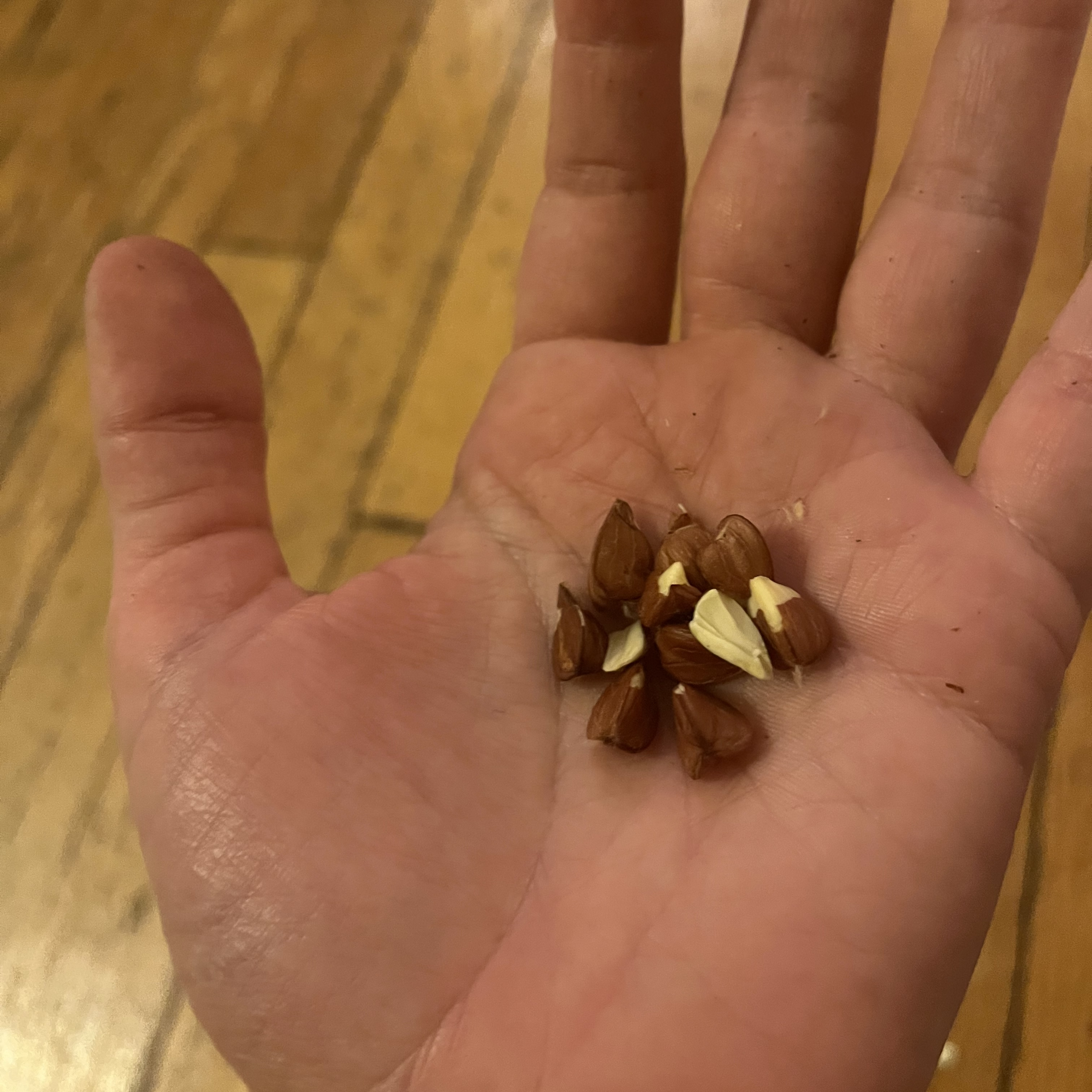
Beech produce small nuts about the size of a sunflower seed. These are commonly nabbed by squirrels and other critters that can reach the canopy and pick off the small nuts. They’re much harder for us two-legged animals on the ground to harvest, but you can sometimes pick them off from lower-handing limbs. Their taste is mild – similar to a pecan – but without significant flavor.
There’s minimal information we could find on yields of beech trees. Some sources claim that they begin producing at 40 and hit peak production at 60. In Europe their local species are mentioned as a food source used during their war-era famines. There is ample interviews on record attesting to the use of beech nuts by Indigenous people on this continent, but less available on-line for how they’re currently used today. The nuts are definitely not a major part of the broader American foodways as we know them.
Unfortunately the beech is currently undergoing a fatal blight known as beech leaf disease, and may vanish from the landscape entirely in a few decades. Many people don’t realize they’re currently living through a landscape transformation similar to the loss of the chestnut a century ago.
Timing, Harvests, and Growth
Open field agriculture has a lot of convenience behind it. Plants take months to mature and harvest, and their yield are dependable. Nut trees and shrubs meanwhile have long lead times and a lot of fluctuations in production.
Oaks and hickories in particular take a long time to grow – their maturation rate is slower than nearly all other food-producing trees. Oaks in particular are long and slow lived. Their thousand-year lifespan balanced by their long childhood – oaks typically begin bearing acorns at about twenty years old, and their peak production is usually at age 50, and trending down after 80. Hickories are similar to oaks in that they reach peak production at around 50, but they don’t slow down. Instead of a thousand years, they only live a few centuries – but they can be continually productive for that entire lifespan once they reach maturity.
We don’t have nearly as much data on the American Chestnut, but we know they bore food much sooner – around a decade or so. This is also true of the Chinese chestnut – which begins bearing within only a few years, and reaches peak production in a few decades. Although the lifespan is often cited as around a century, some trees in China have been found to be over 800 years old. The chinquapin meanwhile lives less than 50 years old, but reaches peak production in 5.
Similar to the oak, hickory nuts have masting cycles. Some studies seem to suggest they may be on a three year cycle – no nuts, some nuts, a lot of nuts, and then back to none – but there’s not high quality data to back them up. Because these cycles are not tied to the oak
In the range of the American Chestnut, there was further protection against bad mast years. Unlike the cyclical oaks and hickories, chestnuts provided a smaller but consistent food source – yielding every single year. This in additional to their thin shells, provided a continual accessible food source to wildlife and people.
Wild nut yields vary year to year, but our calculations based on existing data indicates that on masting years they are comparable to many agricultural crops in terms of calories produced – similar to rutabaga, carrots, and sorghum. That means oak hickory woodlands can be seen as periodic bumper crop sources of hearty food. These yields are major assets in agricultural production, considering the low effort involved in oak management compared to the backbreaking labor of the farm field. Some sources believe that the switch from oaks and other tree crops to annual agriculture may have began as a way to balance out food resources on non-masting years. Notably this is the reverse of what we see now – many people view wild nuts as backup famine food, and veggie crops as the mainstay of our diets.
 Thriving in Scarcity : A book about living well in hard times